Showing posts with label Old Photos. Show all posts

Monday, December 15, 2014

Christmas is Coming


Barely finished with Thanksgiving, I find myself getting Christmas Cards and even boxes in the mail. Before I moved on from Thanksgiving, I wanted to share a photo of my Uncle Jim and Aunt Mary. I found one at my parent's house. In the guest bedroom, my mom keeps a display of family photos that I have found in a variety of old boxes in the attic and other places.


My Uncle Jim and Aunt Mary are in the center. James Joseph Dunn Jr. was a Master Sargent in the Army and was stationed in Germany immediately after WWII. He looks so impossibly young in this photo. Of course, I never saw him as a "young man"!


In the week that follows Thanksgiving, I place grave blankets on my Grandparent's grave - It is my way of telling them I am thankful for all the love and blessings they gave me while they were "with us." They have not been forgotten - and with the onset of their favorite time of the year, They are specially remembered.

My mother's father loved Fruitcake from Collin Street Bakery of Texas - and a can of it was ordered for the family to share on Christmas Day.

My dad's mom loved to sign her gifts "From Santa" and spent the entire year before Christmas looking (and listening) for the perfect gift idea. She always found something that made her grandchild jump up and down in glee.


The recent loss of my dad's father is becoming less recent - but the later years on the gravestone remind me that my dad's father's last Christmas with us was no different - my older brother and I shared a few hours with him in his comfortable bedroom on Christmas Day. As confused as he was with many things, he knew it was Christmas - and that "Kid" (as he called his wife) was greatly missed...and especially so on that day.


And now, I will start writing and send my own Christmas Cards.

Tuesday, November 4, 2014

The Irish Photos

The photos were taken a few years ago on film - so the colors are a little off - but I've tried to clean them up a bit.


I didn't expect to see as many horses, ponies, and donkeys that I did, but they were everywhere there were animals. Cows and sheep far out number even people in Ireland I think.

The license plate says Michigan. Having the dog sit in your lap or on the donkey during the ride was an "extra charge." Someone paid it. :)

This is a convent - Kylemore Abbey & Victorian Walled Garden. The weather with the looming fog made it gleam.

Another shot of the abbey.

This was a "Gentlemen's Horse Farm, Carrigglas Manor. I remember having lunch there but not much more. I understand it is now a ruin.

This was spotted in Carrigglas Manor. My Grandfather made thousands of these - I don't know if this one was one of his though.

The Cliffs of Moher. Simply breath-taking.

More cliffs rising from the sea.

Given my fear of heights, this is as close to the edge as I got!!

No trip to Ireland is complete without a kiss. They lean you over backwards and slide you out over the abyss on your back and you lean upward to kiss the bottom of the Barney Stone. It's a good 85-90 foot drop there...

Back on the houseboat - on the River Shannon - there are "street signs" out on the river so it is hard to get lost!

Everywhere along the river are workingmen and fishing persons with their helper dogs of course!

A considerable climb up from the water - the conic towers are - forgive the pun, iconic. This is Glendalough Monastery in COunty Wicklow.

To get around the rapids and shallows on the River Shannon - usually between the many lakes, you go through a "canal lock". Here is one near Carrick on Shannon.

Waiting near one of the many locks was this family of Swans. There were to be many such families along the route.

Here I am in the yellow rain jacket bringing the boat out of a lock.

A view down into a lock, they crammed as many boats as they could into the lock when things were busy. All the boats had plenty of inflated "boat bumpers" on them. A canal further north was "self serve" and far less busy.

A self serve lock. One inserted a "fare card" into the board and the gates would swing shut and the lock fill or empty depending on which way you were going.

The many cows along the river and streams like to stand out in the water and let the houseboat wake wash over their knees - they were totally un-phased by boat wake.

The monastery of Clonmacnoise (Cluain Mhic Nóis in Irish, meaning "Meadow of the Sons of Nós") is situated in County Offaly, Ireland on the River Shannon south of Athlone.

Clonmacnoise was founded in 546 by St. Ciarán, a young man from Rathcroghan, County Roscommon. Until the 9th century it had close associations with the kings of Connacht. The strategic location of the monastery helped it become a major center of religion, learning, craftsmanship, and trade by the 9th century and it was the most famous in Ireland, visited by scholars from all over Europe. Yes, you read the dates correctly!

The houseboat is docked on a wharf in the River Shannon just below this hill. Another climb up a hill brings you into the "land that time forgot." This is one spooky place!

Here you can see a houseboat on the river approaching the Clonmacnoise dock.

Another houseboat. We shared several days company and a couple trips to local pubs for sing-a-longs. The lady with the camera was very friendly and from Limerick.

The Bed and Breakfast I stayed at both before and after my house-boating cruise.

Another family of swans closes this entry. :)

Tuesday, August 6, 2013

First Cousin - 3x Removed - Part Two

I had no luck in deciphering the names on Marshall Mousley's USS Ohio cap

I investigated the obvious, perhaps one of the ladies was to become his wife? That was not the case, for Marshall married an Elizabeth A. Miller (1910?-1994) in 1936.  Interestingly enough, Elizabeth's father, may have been Fredrick W Miller, who worked as a "hatter" in a "factory."  Could this be the Stetson Hat Factory?

Looking in another direction - I attempted to discover what 35 Ringold B, Trenton, NJ might tell me.  I found a map of the area dated 1908.


I see a house numbered 33 and the place next door labeled "A," but no #35.  Interestingly (to me anyway) is the P and R R.R. Freight House and nearby Philadelphia and Reading (P and R, commonly known as "the Reading") Rail Road Passenger Station.  Being familiar with this area, I was startled to see the railroad tracks - they are long, long LONG gone!!

Today, the scene is vastly different.


As you can see, there is no sign of any railroad facilities!  Also, there is no sign of #33 Ringold Street either.  The monument in the center far right is the Trenton battle monument commemorates the American victory at the first Battle of Trenton, NJ, which occurred on December 26, 1776.  It was completed in 1893.

It isn't clear if it is on the 1908 map - however, today, #35 Ringold Street is the building on the lower right and is home to the Trenton Police Department.  The building with the red A in a balloon is the Reading Senior Citizen Center.  The now vacant field above is where #35 B would have stood.  Stymied!  The Reading Railroad passenger station would have been located where the police department building stands today.

So, I looked into the US Census - picking 1920 as the closest year to 1917-1919, and found an entry for #35 Ringold Street.  It was occupied by a Edward Joseph Fay who was born in Jersey City, Hudson County, New Jersey (born 1873/1877/1881 depending on which source you chose to believe - died 1942), the son of John and Rosa Fay.

Edward's wife was Elizabeth L Fay (1888-1960).  He worked as a brakeman for a "steam railroad."  I wouldn't be surprised if it was for the Reading Railroad.  If not, the Pennsylvania Railroad had a number of branch line tracks only a short stone throw away., including what is now the "Northeast Corridor" for Amtrak.  The census was just about illegible...


I checked the "nearby" neighbor's names - and found none that possibly match with any of the names on Marshall's hat, including Marshall's!

I then looked into the service record for the USS Ohio, and found that this battleship served as a "training classroom" for new recruits - to quote Wikipedia, "Soon after the United States entered World War I [the USS] Ohio [was] recommissioned on 24 April 1917. Throughout the war, she operated out of Norfolk, training crews for the expanding fleet, taking part in battleship maneuvers. She arrived at Philadelphia on 28 November 1918 and was placed in reserve there on 7 January 1919."  Coincidentally(?), Marshall's discharge date aligns with the date the battleship was placed in reserve.  I would conjecture that Marshall was never far from home (Philadelphia) during WWI and spent most of the War in Norfolk, Virginia or at "home" in the Philadelphia Naval Yard..

Stymied for the moment, I did come across something interesting.  The cousin of mine - the one that sent me the photos of Marshall and his brothers - that I posted (here) - when I told him of Marshall's cap, tells me that he has a photo of Marshall's brother Elmer wearing a similar cap!  I await seeing this photo!

Thursday, July 5, 2012

Going To Try...

I'm going to try to post something today.

I've said that daily for about 4 weeks.

Then the motivation dribbles out onto the floor... and runs down the drain.

Deep breath.

Gonna try to "do it" this time...

It's been hard, really hard to find energy and motivation... one could blame this awful heat we've been having it... but I know that's not it...

Recently, I've been contacted by a "never met, distant cousin" who wrote to me saying, "Hey, would you be interested in some old photos we were given (from the settling of an estate) that appear to have the 'Mousley Crew' in them? We received several old boxes full of albums."

Of course, I said, "Yes!"

3 skinny young men stacked up on each other's shoulders
From the bottom, Franklin, Marshall, and Elmer. I've written about Franklin before, he with the diary dating to 1910-1912, and Elmer, an electrical engineer that helped set up one of the first trans-Atlantic radio stations in Tuckerton, NJ.

These gentlemen were my cousins, 3 times removed or my great-grandfather's cousins. They must have been a handful while growing up.

Which brings us to the connection between me and my "never met cousin" that sent me the photos.

a kindly looking older woman standing in her garden
Sarah "Sadie" Mousley was the wife of Thomas Charles Mousley and the mother of Franklin, Marshall and Elmer. I think I would have liked Sadie... there is something in her expression that hints of fine humor.

Thomas C., ran a brass foundry his father (my 3rd great grandfather) started in Philadelphia back around 1860.

Sadie's brother George Hammond had a daughter named Grace, who apparently assembled all of the recently uncovered photo albums. Sadie was Grace's aunt.

a crowd of people down on the farm
In the album are photos of Franklin, Elmer and Marshall as young boys and later men, in various locations like "down on the farm" "at the beach" (Wildwood, NJ) and what looks like somewhere in Philadelphia, likely the Mousley or the Hammond home.

Above we see in the back row (left to right): Marshall, Papa (George Hammond), Elmer, Thomas C., Leon(?) and in the front: Jas. W.(?), Mrs. S(treitz?), Sadie Mousley, Florence Sailor(?), and Franklin holding George (Hammond Jr.?)

I don't think Franklin changed much in his appearance over the years. I'm going to sort out the other photos and figure out who these other people are - hopefully soon.

There. I did it. I posted something. I need to give myself a high-five. Now to tackle several hundreds of unread posts you've written the past 6 weeks or more.

Got to try...

Tuesday, April 10, 2012

Mom's Old Photos

First things first - a couple updates:

1) The diary of my cousin Commodore Franklin Mousley is being digitized as I type. A very helpful person from Rights and Reproduction is making a PDF copy of the diary for me at a most reasonable price! I'm so excited!

2) The search for Henry Casselberry continues - he hasn't been found yet. I did, however find many of his eight children and even more of his grandchildren. The current search appears to be leading me back towards Germantown. I need to review some old history books and look at some old maps to see where he might have been buried. I have found one reference that states, "The early Mennonites didn't concern themselves overly much with gravestones. The believed the good Lord knew where to find them."

With that in mind, humbled, I will take failing to find the gravestone in stride - I'm just a bit disappointed for the 8-times great-granddaughter and last of her family's line, that I might not find it. She's been delighted with all the children and grandchildren gravestone photos.

She says, "They (the photos) makes the dusty records of ghostly people, become so real once more. They *did* exist, live and breathe." And that's good enough for me.


************************

This past weekend, my mom pulled out a handful of old snapshots.  This is her, in about 1940-ish.  Location unknown but probably in the Boston, Massachusetts area.


In 1957, my Grandfather wanted to attend his family's annual reunion.  My grandmother did not want to go.  She disliked the very long car ride from Massachusetts to Oklahoma in the hot summer months.  Their car was "up in years" and not terribly dependable.  My grandfather usually gave way to my grandmother's quirks and whims, but this time he put his foot down and said (according to my mother), "Cornsarnit woman, I'm going even if it means leaving you behind! I'll take the boy (my cousin) and the girl (my mother) with me and go without you!  So if you're going, pack a bag and gits in the car!

She packed a bag, mumbling the whole time, and got in the car. The car broke down somewhere in western New York and it took several days for it to be repaired.  The week-long vacation with the reunion in Oklahoma became a visit of only a couple days.


The 1953 family reunion in Calera, Oklahoma. My grandfather was one of seven children, and he had an additional three step-siblings.  I must confess to enjoying the names (even if they confuse things to no end!)  From left to right, Charlie Clyde (yes, she's a woman), Donna, Olive, Margaret (my great-grannie Maggie who was 4' 7", killed rattlesnakes and chickens barehanded "fer eatins"), towering behind her is Tack (real name Lowell, Charlie's husband), my grandfather with the stylish wide tie and beset upon look, Barbara Ann, Bubba (real name George), and my Grandmother.

My mom says, this is the only time she ever met all of these kin folks.  She got married a few years later and had some little boys that kept her busy.
  

Namely me and my socking-footed pajama wearing older brother.  My Granddad looks pretty happy to have me sprawled out in his lap while hanging on to my brother.  My Grandmom had a nice smile and a tender chuckle when she laughed.  I wonder where this photo was taken.  I suspect it was during a visit to New Hampshire.

Friday, March 23, 2012

Mathias Gmelin (1677-1756)

While searching for the gravestone of another early German immigrant by the name of Heinrich Kasselberg (1670-1729) for Find-A-Grave request, I went to the nearby Methacton Mennonite cemetery. It was a dreary overcast day, one that had begun with a heavy fog. A day just perfect for wandering around an old burial ground!

marker in the wall at the cemetery
In the wall surrounding the cemetery, one finds a commemorative marker that begins, "This marks the place of the first church house built prior to 1771." The local historic society says the "oldest surviving stone in the cemetery (and within the township) appears to be that of George Beyer, age 4, dating to 1744, when this was a neighborhood cemetery."

So that rules out finding Henry Kasselberg here...

A giant white oak marks the northwest corner of the cemetery. The oak is estimated to be 300+ years old and may be the oldest living object east of the Mississippi River. I've written about this tree before.
a huge bare tree, the leaves have not appeared yet
I decided to see where Henry's offspring were buried, as there were several mentioned in the records. So I began to thread the rows of the cemetery noting the familiar family names. Some family names are remembered as street names, others as neighbohood areas.

Eventually, I came across this old stone. Typical of the period, it is inscribed in German.
old gravestone
I carefully wrote what it said in my notebook --

"Hier ruhet die Gebiene den
verstorbenen Mathias Gm
elin gebohren Im jahr 1677
Den 31 Jan Gestorben Im
jahr 1756 den 17 April
Seines Alter 79 jahr
2 Monath 2 Wochen
Und 3 T"

"Here rests the bones of Mathias Gmelin born in year 1677 on January 31 died in year 1756 on 17 April. His age 79 year 2 month 2 weeks and 3 days "

Born in Vaihingen an der Enz, son of Jeremias and Christina (Zimmerman) Gmelin. Grandson of Jeremias Gmelin, Lutheran pastor of some renown in Auggen, Germany. Mathias became a Pietist (The Pietist movement combined the Lutheranism of the time with the emphasis on individual piety and living a vigorous Christian life - which influenced the Mennonite and Amish) and became a member of the Schwazenau Brethren, and eventually immigrated to America. He was naturalized in Philadelphia Co. 9 Jan 1729/30. He settled at Methacton in Worcester Township. He was a farmer and also a glazier (a person whose profession is fitting glass into windows and doors) by trade.

He is a typical example of a German immigrant of the time. The Germans settled Germantown, about 10 miles west of Philadelphia, because the English-speaking residents of the growing city, including no less than Benjamin Franklin, told them "to keep going up the Schuylkill river, they were not wanted there" deeming them to be "...generally of the most ignorant Stupid Sort of their own Nation..."

Eye-opening, huh?

Wednesday, February 15, 2012

Reaching Intertwined Roots

Last Sunday, I bought a new pair of walking shoes and retired a beat up, old, smelly pair. The old ones were oh-so-comfy, and the new ones oh-so-stiff and unyielding.

I decided that in order to break the new shoes in a little, I would venture over to Mill Grove, the home of John James Audubon and walk on the grass and dirt trails to give my feet some cushion.

a row of towering white barked sycamore trees
While moseying around the meandering trails, I saw some Hawks high in the trees but was more taken by the white bark of the Sycamores. I found myself looking into the bright blue skies more and more and nearly tripped over...

a marker
...this marker. It reads "Those that truly love, have roots that grow towards each other underground, and when all the pretty blossom have fallen from their branches, they find that they are one tree and not two."

I later found this to be a quote from "Captain Corelli's Mandolin" by Louis de Bernieres. In full, it goes:

Love is a temporary madness,
it erupts like volcanoes and then subsides.
And when it subsides you have to make a decision.
You have to work out whether your roots have so entwined together
that it is inconceivable that you should ever part.
Because this is what love is.
Love is not breathlessness,
it is not excitement,
it is not the promulgation of eternal passion.
That is just being "in love" which any fool can do.
Love itself is what is left over when being in love has burned away,
and this is both an art and a fortunate accident.
Those that truly love, have roots that grow towards each other underground,
and when all the pretty blossom have fallen from their branches,
they find that they are one tree and not two.


an old photo of my dad with his mom from about 1948
After my walk, I sat to rest my beat up feet and looked at this photograph that my Honorary Aunt Bea sent me in the mail that weekend. It is undated and unmarked. But I'd recognize that location any day. This was one of my grandmother's favorite photo op spots (note the last two photos taken about 25 years later).

It wasn't until later, after reading what Far Side of Fifty wrote about the old fashioned flashbulbs and reminded me of how troublesome they were, that I realized that my Grandmother liked this spot because it was in direct sunlight and it was right outside the kitchen door. Now I know why at least half of the old photographs she either took or had taken, were done at this very spot!

This is my Dad (who claims to not remember what the event might of been) standing with my Grandmother outside the kitchen door of their house in Phildadelphia, Pennsylvania. The best we can do dating this photo is "about 1948".

my Dad dressed in his Army uniform holding my big brother in his arms 1959
Here is an early color picture of my Dad dressed in his Army uniform holding my big brother in his arms. I wasn't born yet at the time this picture was taken in the spring of 1959. It was taken in the lawn area just off the walkway.

Later, my gardening-crazed Grandmother would have a row of red Azalea bushes planted along the walkway leading to the front of the house.

My family has some very deep, intertwined roots on, under and around that unremarkable slab of concrete.

Sunday, February 5, 2012

Those Swedes!

While the major Swedish immigration to the United States did not occur until 1870-1910, when over one million Swedes arrived, settling particularly in Minnesota and other states of the Upper Midwest, the Swedes were in North America long before that.

The first Swedish expedition to North America embarked from the port of Gothenburg, Sweden in late 1637 and the community that gradually expanded along the banks of the Delaware River called itself "Nya Sverige." In English, this means "New Sweden."

If one Swedish colonist had to be chosen to stand for them all, perhaps there is no better candidate than Peter Gunnarsson Rambo. He came to New Sweden from Hisingen, now a suburb of the major seaport of Gothenburg, in 1640. Peter Rambo brought with him "apple seeds in a box." A few years later he married a girl who had come here from Vaasa, Finland. Peter Rambo's apples are still grown locally.

William Penn first stepped ashore in America in 1682 at the Swedish village of Upland—which as the "new owner," he promptly renamed Chester. Penn soon learned to count on experienced Swedish fur traders to act as interpreters when he negotiated treaties or bought land from the Delaware and Susquehannock Indians. And when his agents had picked a site for the great metropolis that he was planning, Penn found it expedient to buy the land from three Swedish brothers named Svensson. They were farmers, as their father had been, in what is now downtown Philadelphia.

The town the I live in, Norristown, was originally called Swedesford. Peter Rambo is buried in a churchyard a couple miles down the road.

The Swedes spread up the Schyullkill River from Philadelphia towards the site of what would become Reading, PA. About half way between these two iconic Pennsylvania cities, is the hamlet of Douglassville. And in Douglassville, one finds the oldest house in Berks County.


The house is a little off the beaten track. The sign points the way.

Monce Jones (Jonasson), the son of Jonas Nielson and Gertrude Y Svensdotter was born 1663 in Philadelphia, PA, USA, and died March 29, 1728 in Douglassville, Berks County, PA, USA. He married Ingeborg Peterssdatter Laikan Lycon, the daughter of Peter Nilsson Laikan Lycon.

I wonder just what pet name Mounce had for Ingeborg...


As the access road was deeply rutted and rather wet, I decided to walk into the site last weekend. I took this picture of a big leaf for a Swede I know, some time ago.


The access road turns into a long driveway. The house stands along the Schuyllkill River.


I think the front of the house faced the river. There is a fenced in herb garden just outside the front door.


The opposite side of the house has a prominent oven built into it.


The end of the house has one, very small window - I think this is because glass was imported from the old country (likely England) and was very expensive.


I thought the window was interesting enough to take a close up of it. It is rather plain.


In the "front" of the house, above the entrance way, is a marker that shows "I M I 1716". I pondered this for a while, I think the top "I" is an old style "J", and that the "M" and "I" below that might be Mounce and Ingeborg's initials. There was no one to be found in this little park, so I resorted to asking Mr. Google to no avail.

But...

Mr. Google did turn up something most intriguing. It seems that there are very (as in incredibly) old photographs showing the contents of some unsuspecting immigrating Swede's luggage. Which, no doubt...


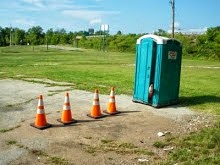
...shows how the Orange Cones came to America. This rare photo shows three members of the most invasive species known to the human race that hitched a ride from the old country...

Inscribed on the back, it says, "Harold Coneson and Jenny Ochasdatter, arrive in America with little Peter Haroldsson in 1684. Jenny was claimed to have been the first to use the newfangled traveler's pillow."

With my feeble computer skills, I was able to greatly enhance and colorize the photograph.


Submitted for your approval -