Friday, March 21, 2008

Return to Fairmount Park

What a difference a week (and some sunshine) makes.


The Cherry trees are in bloom! - I took these pictures today (March 21, 2008) and this picture was taken within a few feet of the one that I took last week on the gloomy day. The white Cherry trees have not blossomed yet, but will in a week or so.

The black statue in the background near the Sycamore tree is General U.S. Grant and the arched bridge is for the Baltimore and Ohio (B&O) Railroad.


Blossoms up close - The Schuylkill River is in the background. The river was very high, very muddy, and frothy from the wind.


Find Waldo the American Robin - The white streak in the river is a racing shell (row boat) full of rowers going up and down the river. Today was a COLD one for rowing, but tomorrow is an all-woman rowers regatta and the ladies were out there practicing hard.

I have 3 or 4 more pictures, I'll probably post them on Monday when I can upload them within a lifetime (yes, Dial-up can be a joy)

William Penn 1644 – 1718

As of March 21, 2008 at 8:30 AM
Steps: 1,913,281
Miles: 806.76

A note: The Virtual Walker will be back as soon as he plods his way out of Puddin' Swamp and actually gets somewhere of note. In the meantime, The Real World Walker will be doing some blogs.

Neither walker walked (much) on Wednesday as it was raining and their legs were weary. You may recall, during a walk in Fairmount Park, mention of the City Hall with it's statue of William Penn. William Penn was an interesting man.


William Penn (October 14, 1644 – July 30, 1718) was founder and "Absolute Proprietor" of the Province of Pennsylvania, the English North American colony and the future U.S. state of Pennsylvania. He was known as an early champion of democracy and religious freedom and famous for his treaty with the Lenape Indians.

King Charles II of England had a large loan from Penn's father, after whose death, King Charles settled by granting Penn a large area west and south of New Jersey on March 4, 1681. Penn called the area Sylvania (Latin for woods), which the King changed to Pennsylvania in honor of the elder Penn. One of the first counties of Pennsylvania was called Bucks County, named after Buckinghamshire in England, the Penn family seat and original home of many of the first settlers.

The freedom of religion in Pennsylvania (complete freedom of religion for everybody who believed in God) brought not only English, Welsh, German and Dutch Quakers to the colony, but also Huguenots (French Protestants), Mennonites, Amish, Catholics, Lutherans from Catholic German states, and Jews.

William Penn's ideas were later studied by Benjamin Franklin as well as the pamphleteer of the American Revolution, Thomas Paine, whose father was also a Quaker.

From 1682 to 1684 Penn lived in the Province of Pennsylvania. Penn designed the City of Philadelphia ("Brotherly Love") and conceived of it as a "greene Country Towne". His design for the city was in a rectangular grid with large lots, dividing the city into four quadrants.

Penn suffered a stroke, in 1712, after which he was unable to speak or take care of himself and died in 1718 in England.


William Penn stands on the top of City Hall.
- It is 548 feet from the ground to the top of his hat.


Here is the statue on the ground before being placed on top of City Hall in 1894. Gives you an idea of how large this statue is and why it can be seen from miles away. This bronze statue was designed by Alexander Milne Calder (1846-1923) and is the tallest statue on any building in the world. It stands 37 feet tall and weights 53,348 lbs (24,200 kgs / 27 tons.)

Statue Facts


For many years, William Penn atop City Hall was the highest vantage point in the City. It was only recently, even I can remember it, that buildings higher than the William Penn statue were built inside the city.

Thursday, March 20, 2008

Well? What The Heck!?

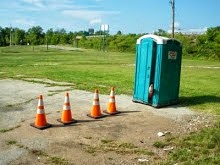
With the end of Lent just days away, I am keenly looking forward to being able to once again photograph Orange Coneheads. A keenness further sharpened by this picture sent to me by someone who didn't want to be named.

I've been looking at this gem for nearly hour and am still speechless - such a mind-boggling photograph!


But just what... the heck is going on here?

The pink bathrobe on the wrough iron fence, not to mention the well painted blue skid, really, really throws my mind into a jumble.

I first thought, well, gee, homeless Orange Coneheads with their shopping cart and kegs of beer, what else could this be, besides an obvious case of some Orange Coneheads losing their livelihoods and homes to one or more Orange Striped Barrels.

- Is the blue skid... is this a symbol of their being on skid row?
- What are we to make of the pink bathrobe?
- What's the social position of the Yellow Triangle-sided Anti-Parker?
--Is the YTA a pet? a butler? slave?

I'm going to have to ask for help here folks... What do you think?

Black Swan Petra Saga

Black swan 'Petra' welcomes her 'partner', a swan-shaped pedal boat at a small lake at the Zoo in Muenster, western Germany.

A long love story is over at a German zoo: Petra the swan and her swan-shaped paddleboat are parting ways. Petra, a black swan, became a minor celebrity in 2006 when she became so attached to the boat — which is shaped like an oversized white swan — that she refused to leave its side. Officials in the western city of Muenster decided to let her stay with it over the winter, bringing both bird and boat into a city zoo.

However, Petra met a live swan this winter. Zoo director Joerg Adler says she and her new mate — a white swan — are building a nest together. The boat is to be returned to its local owner on Thursday.

(AP Photo/Frank Augstein/file) - Source

Okay, I'm sappy, I found this heartwarming.