Thursday, April 3, 2008

The Wrong Blueprint

In a rush this morning to get to work, I picked up the wrong blueprint. The blueprint that I wanted was one from the Phoenix Iron and Steel Company. Oh well, I scanned in parts of the one I that I had - one from the Worth Steel Company that was in Claymont, Delaware.

Then I partially remembered, Worth Steel was bought out by Phoenix Steel on September 30, 1960, so this drawing was one for "Phoenix Steel", but its still not the drawing I intended to pick up.

Bear in mind this blueprint is 30 inches high by 42 inches wide.


A small section of blueprint

The drawing is for a machine part and is labeled "Hydraulic System - Gen. Arrgt & Details of 3/4 inch 4 Way Operating Valve, 1500#"

I used to have to read blueprints such as this when I worked for my Dad at our family's non-ferrous (anything but iron and steel) foundry. My Dad cast lots of the brass, bronze, and aluminum parts that went into machinery all over the place.


Black and white scan to enhance details

Time worn, the blueprint ink has colored places that were white when the drawing was new. This drawing was drawn by "S" and completed on February 5, 1922 after being checked by "Smith". It was then kept in drawer number 590.

I guess with over 590 drawers full of drawings, they couldn't change the name from Worth Steel to Phoenix Steel on all of them!

This only thing of note otherwise is that the part required 2 leather washers and they changed the type of bronze the body of the part was made from on February 24, 1958. A part similar to this one might well be out in the ruins in the fields at Phoenixville.

The thoughts that I have aren't with the "ruins" but rather, I am grappling with the notion that Mr. "S" (and Mr. "Smith", if he was a different person), was almost certainly a man; is with even more certainty, dead; probably never used a computer; and most likely never saw the Internet. In some small way, this entry is a memorial to "him".

P.s., the Virtual Walker will be back tomorrow. He's been demanding equal time.

P.s.s., The steel company in Claymont still exists, but has changed hands. The Phoenix Steel plant there was bought by Citi Steel, a Chinese firm and is now called Claymont Steel.

Return to the Bottle Tree

As of April 3, 2008 at 8:00 AM
Steps: 2,156,722
Miles: 906.59


Back a while ago, I wrote about bottles in a Tree. This is a new picture that I took yesterday in bright sunlight.

I recently did some digging and discovered the reason why some people do this.

Slaves from the Congo in Africa brought the idea of the traditional bottle trees -- live trees with colored bottles on the ends of branches -- into this country. Bottle trees protected the homes from evil spirits by trapping spirits inside the bottles, where they could do no harm.

Apparently, blue colored bottles are preferred, and you really don't ever want to break a bottle since the trapped evil spirit(s) then escapes.


Now that I know this, I can sleep better at nights.

You can buy your own tree if you want

Wednesday, April 2, 2008

A Study in Contrasts

As of April 2, 2008 at 7:30 AM
Steps: 2,138,446
Miles: 899.09

On Sunday March 30, 2008, I went to Phoenixville to explore the Phoenixville Iron Trail. This trail is ...a very sharp contrast from the green, quietness of the natural setting of the Valley Forge National Historical Park's Riverside Trail which is only 4 1/2 miles downstream from here.

For many years, the Borough of Phoenixville was the home of the Phoenix Iron and Steel Company which was established in 1783. The works, created from a modified grist mill, was the site of many metalworking firsts in America, including rolling of iron nails, structural shapes and beams as well as the invention and production of the spiral wrought iron Griffen gun (a cannon used in the Civil War).


Wrought Iron Phoenix Column

The Phoenixville Works also invented and produced the hollow wrought iron Phoenix column (used in many bridges, including the Kinzua Viaduct).


I searched for pictures of the place before it was torn down. I know this not the best, but hopefully it gives you some idea of what the place was like. This is the pipe mill. This is only one of the many buildings on the site and most of them were covered in what looked like black tar paper.


Demolition of the Open Hearth Building

For many years, my father supplied the steel works with many parts used to repair their machinery. I remember numerous occasions where I rode with him or my mom, to deliver them. I have a blueprint of a part used in an overhead crane dated 1912 in my possession. I remember when the place was torn down after it closed forever in 1987.


The Site of the Works Today

I think the Phoenxville Iron Trail starts here (its not marked) and follows the French Creek down the right hand side of this (now) open field.


Rusting Gear

A stark image that explains the term "rust belt".


A flywheel slowly turns to Rust

The Phoenix has not yet risen from these ashes. I came away rather shaken by the demise and ruin of a place I had ties to.

More pictures from Phoenixville Steel Site

A website with a very nice write up on the history of the mill

Tuesday, April 1, 2008

Down By The Riverside

As of April 1, 2008 at 8:30 AM
Steps: 2,119,120
Miles: 891.16

On Saturday March 29, 2008, I went to the Valley Forge National Historical Park to see if I could find Fatland Ford on the south side of the Schuylkill River. This is the side opposite from the Riverside Trail where I inconclusively looked for the ford earlier in the week.

While I was there searching, I took some pictures of the heart of the park.

There was no battle between the British and the Continental Army at Valley Forge. Washington's army spent the winter of 1777-1778 here in an encampment. Here they waited for warmer weather before resuming activities against the British Army. While here, the Continental Army did battle disease, wet and cold weather, and poor morale. By May of 1778, they emerged from Valley Forge trained fighting men and in high spirits since the French government had joined the Patriots in fighting the British. So the park land was really just a big campground.


Major General Armstrong Monument

The monument reads "Major General John Armstrong in command of the Pennsylvania Militia guarded the roads from Philadelphia and the approaches to Sullivan's Bridge and the camp."

You can see Saint Gabriel's Reform School through the words and over the river just to the right of the stone. In the 40+ years of living near the park, I had never seen this monument before as it is tucked into the woods well away from the roads.

I went down the wagon road behind the Armstrong Monument and walked along the Reading Railroad (now Norfolk Southern) for several miles but could not get a clear view of the river! Fatland Ford remains to be found. Maybe when the water levels recede in the summer I will go back and try again. Enjoying the day regardless, I climbed back up the hill and walked through the heart of the park back to my car.


Saint Gabriel's and the Fatland Ford Estate

From the top of the hill, on the shoulder of Mount Joy, one can see a long way. The river is down in the valley between me and Saint Gabriel's. The white building to the right is the Fatland Ford Estate. Mill Grove, the home of J. J. Audubon, is behind those two buildings.


Ugh! Just Ugh!!

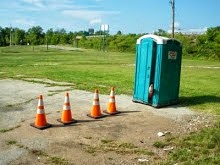
Nearly back to my car and close to the buildings used by General George Washington for his headquarters I spot this pair. I am seriously started to get creeped out by Orange Coneheads. I wonder what the furthest distance is that I can go before sighting them? Can I even go a whole mile? Are these two Harold and Delores who missed the train to Cleveland?


A reproduction of a typical soldier's hut

There are many of these scattered throughout the Valley Forge area. I took many pictures on the encampment grounds but show only a few here.

Pictures from Valley Forge if you are interested

Tomorrow I'll post an entry on the Phoenixville Iron Trail. Phoenixville is only 4 1/2 miles up the Schuylkill River from where these pictures were taken. It was a whole different world.